
Posted on 11th May 2026

Print continued to navigate a challenging operating environment over the past year, with the latest Audit Bureau of Circulations (ABC) data for July–December 2025, accessed by e4m, showing that only a few of India’s leading Hindi dailies were able to post year-on-year circulation growth, while most major publications reported declines.
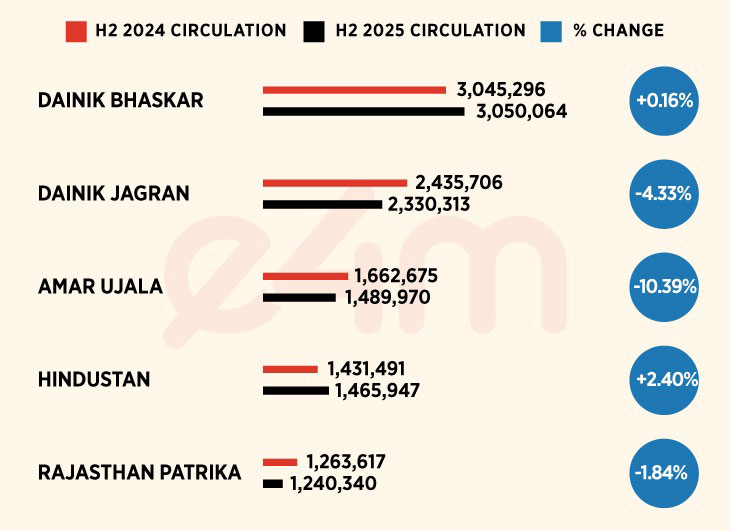
The ABC data shows a market where leadership remains intact but growth is becoming increasingly selective. While Dainik Bhaskar and Hindustan reported modest gains in circulation, Dainik Jagran, Amar Ujala and Rajasthan Patrika registered declines during the period.
Dainik Bhaskar retained its position as the largest Hindi daily among the publications analysed, reporting a total circulation of 3,050,064 copies in H2 2025, marginally up from 3,045,296 copies in the corresponding period last year. The increase of 4,768 copies translates to a growth of 0.16%. Dainik Jagran, meanwhile, reported a circulation of 2,330,313 copies, down from 2,435,706 copies a year earlier, reflecting a decline of 4.33%.
Amar Ujala also witnessed a decline, with circulation falling to 1,489,970 copies from 1,662,675 copies in H2 2024, a drop of around 10.39%. Rajasthan Patrika reported a total circulation of 1,240,340 copies in H2 2025, down from 1,263,617 copies in the year-ago period, reflecting a decline of 1.84%.
In contrast, Hindustan reported growth of 2.40%, with circulation increasing to 1,465,947 copies from 1,431,491 copies in the previous year.
Rakesh Goswami, COO, Dainik Bhaskar Group, attributed the stability to a combination of editorial differentiation, localised editions and distribution-led execution.
According to Goswami, the publisher has been focusing on strengthening reader engagement and expanding distribution efficiency across core markets, particularly in Rajasthan and Madhya Pradesh. He added that variant editions, hyperlocal content and direct reader outreach programmes continue to play an important role in retention and acquisition efforts.
The company has also been investing in distribution infrastructure and trade partnerships to improve last-mile delivery and circulation efficiency across key cities.
Indra Narayan Das, National Circulation Head, HT Media Group, said the growth in their circulation number was driven largely by reader trust and the publication’s continued focus on hyperlocal coverage across Hindi belt markets.
Das said variant editions in markets such as Kanpur and Lucknow have helped the newspaper cater to local reader preferences more effectively, while stronger coordination with distribution partners has supported reach expansion and last-mile delivery.
These shifts come against a broader backdrop of pressure on print. According to the EY M&E Report 2026, circulation revenues declined by around 1% in 2025, marking the second consecutive year of contraction. For most publications, revenues either remained flat or fell, underscoring the limited headroom for growth in the current environment.
However, despite the challenges, Hindi print continues to hold importance within India’s media economy. According to the EY M&E Report 2026, English and Hindi publications together accounted for 67% of total newspaper advertising volumes in 2025, with Hindi alone contributing 37%, the highest among all language segments. The report attributed this to Hindi print’s deep penetration across markets and sustained advertiser relevance.
Regional concentration and city dominance shape circulation trends
A closer reading of the data suggests that Hindi print remains deeply tied to regional strongholds, with publishers continuing to derive scale from concentrated geographies rather than broad-based national expansion.
For Dainik Jagran, Kanpur emerged as the largest centre with 143,598 copies, followed by Patna at 112,518 copies and Lucknow at 106,656 copies. Delhi, Varanasi and Meerut also contributed significantly, underscoring the publication’s continued strength across Uttar Pradesh and Bihar.
Dainik Bhaskar’s circulation remains anchored in Rajasthan and Madhya Pradesh. Jaipur emerged as its largest market with 364,001 copies, while Indore and Bhopal reported 147,827 copies and 141,559 copies respectively. Jabalpur and Jodhpur also remained significant centres.
Rajasthan Patrika similarly continues to derive the bulk of its circulation from Rajasthan markets. Jaipur remained its largest centre with 371,305 copies, supported strongly by variant editions, while Jodhpur and Kota contributed 94,514 copies and 67,658 copies respectively.
Amar Ujala’s circulation footprint continues to be concentrated across Uttar Pradesh markets, with Kanpur, Lucknow, Agra and Meerut among its top-performing centres. The publication’s Ghaziabad edition contributed nearly 40,000 copies.
Hindustan, meanwhile, remains heavily anchored in Bihar and the Hindi belt markets of North India. New Delhi led with 150,566 copies, followed closely by Patna at 133,439 copies. Kanpur and Lucknow contributed over 85,000 and 72,000 copies respectively, while Muzaffarpur added another 47,318 copies.
The broader pattern indicates that scale in Hindi print is increasingly being driven by regional concentration and strong city-level distribution rather than national diversification.
Variants, distribution and execution continue to separate performers
One of the clearer trends in the data is the role of variant editions and distribution-led execution in sustaining circulation.
Dainik Bhaskar and Rajasthan Patrika both reflect strong reliance on variant editions in core markets. In Jaipur especially, variants contribute significantly to circulation, highlighting the growing importance of segmented distribution strategies within regional strongholds.
Dainik Jagran and Amar Ujala also continue to leverage variants across key Uttar Pradesh centres, though to a relatively lower extent compared to Bhaskar.
Hindustan, meanwhile, appears more reliant on core editions, with limited variant contribution outside select markets such as Kanpur and Lucknow.
Industry observers say the circulation battle in print is increasingly operational rather than purely editorial. Distribution efficiency, vendor relationships and localised reader engagement are becoming central to maintaining scale.
The EY report similarly noted that publishers are prioritising retention alongside reach, with circulation strategies increasingly focused on strengthening existing distribution networks instead of aggressive expansion.
Beyond print: events and on-ground engagement emerge as growth areas
As traditional print advertising growth moderates, publishers are increasingly diversifying into events and on-ground activations.
According to the EY M&E Report 2026, events emerged as a high-growth area for the print sector, with publishers scaling their activation businesses significantly. The report noted that the ten print companies surveyed collectively delivered over 1,500 events during the year, ranging from large-format activations to compact community engagements.
Hindi publishers, in particular, have been expanding reader-facing initiatives and branded properties as extensions of their print franchises.
Dainik Jagran continued to scale properties such as the Jagran Film Festival and Bharat Raksha Parv, while also launching initiatives like “Janhit Jagran”, a grant-led platform supporting startups and social entrepreneurship.
DB Corp, publisher of Dainik Bhaskar, has also expanded engagement-led initiatives across markets through community campaigns, reader-connect programmes and on-ground activities aimed at strengthening local engagement.
Amar Ujala has similarly strengthened engagement-led properties, including education-focused initiatives such as the Amar Ujala National Olympiad.
For publishers, these initiatives are increasingly becoming extensions of the print brand itself, helping deepen reader engagement while opening newer revenue streams beyond traditional advertising and circulation.
An ageing readership and a changing print economy
Despite the resilience of Hindi print relative to several regional language markets, structural shifts in consumption remain visible.
The EY report notes that newspapers are increasingly skewing towards readers aged 35 and above, while younger audiences continue to move to digital platforms for news consumption.
This has implications for both circulation and advertising. While Hindi print continues to command scale and advertiser confidence, publishers are increasingly focusing on retention, hyperlocal engagement and premium content strategies to sustain readership.
The fact that Hindi remains the single-largest contributor to newspaper advertising volumes also highlights the continued relevance of the segment, particularly in Tier II and Tier III markets where print penetration remains strong.
Print’s next phase: deeper regional strength
Taken together, the latest ABC data points to a Hindi newspaper market that remains sizeable and influential, but increasingly segmented.
Dainik Bhaskar and Hindustan demonstrate that selective growth is still achievable through strong regional positioning, hyperlocal relevance and distribution execution. Rajasthan Patrika, despite a modest decline, continues to retain deep dominance within Rajasthan, while Dainik Jagran and Amar Ujala reflect the pressures facing legacy scale players in a changing consumption environment.
As the print industry adapts to evolving reader habits, the next phase of growth is likely to depend less on expansion into newer territories and more on strengthening dominance within existing markets while building adjacent revenue streams around the core print business.