Posted on 5th May 2026
by e4m
Print advertising is being shaped less by volume and more by value. Data from recent studies shows a clear shift towards high-impact formats, with advertisers increasingly choosing premium placements and innovation-led executions to drive visibility and engagement.
The top five innovative ad layouts together accounted for just a marginal percent of total print ad space, with masthead integrations leading, followed by augmented reality integrations and formats such as figured outlines and French windows, according to a recent TAM AdEx report.
At first glance, the numbers appear modest. But industry experts contend that the significance lies not in scale, but in strategic intent.
Moreover, Jacket-Full Page formats emerged as the most preferred ad position across newspapers and magazines during the year, with over 8,800 brands leveraging this format.
This preference aligns with a broader industry pivot. According to the EY report, ad insertion volumes grew by 2 per cent in 2025, while ad rates remained largely flat. Growth, instead, was driven by a higher mix of premium formats such as jackets, full pages, and contextual placements, reflecting a clear focus on yield over volume.
The masthead premium
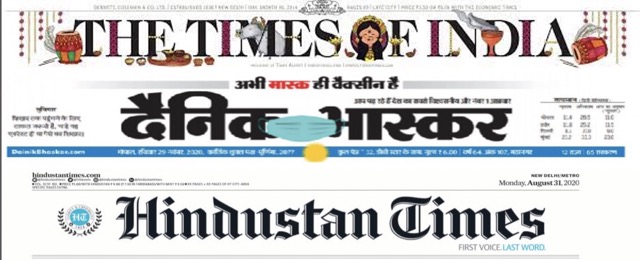
Among innovative formats, masthead integrations stood out as the most prominent in 2025. Positioned at the most visible part of the newspaper, these formats combine scarcity with maximum reach.
Reinforcing this shift, Surinder Chawla, President Response and Brand Capital at BCCL, says the industry is moving away from format-led thinking to objective-led planning. “The choice of format is driven by the brand’s communication objective, target audience, and intended outcome,” he says.
He adds that masthead integrations are typically leveraged for scale, dominance, and premium visibility, while AR and VR-led executions bring in engagement, interactivity, and layered storytelling. “Each format plays a distinct role within the communication mix, and brands do not evaluate formats in isolation on cost alone,” Chawla says.
Saurabh Sharma, Head of Marketing at HT Media Group, says masthead integrations are typically priced at two to five times standard front-page inventory, often with additional premiums for exclusivity and multi-city scale. “Mastheads deliver dominance, especially for categories that rely on instant salience such as FMCG, auto, and government campaigns,” he says.
Anup Mathew, Senior Vice President, Media Solutions at Mathrubhumi Group, adds that mastheads are fundamentally about reach and prestige. “They ensure that everyone sees the advertisement on the day it is printed, and effectiveness is measured through brand lift, recall, and search spikes,” he says.
Manoj Singh, Consultant at MangoData, says mastheads continue to anchor high-decibel campaigns. “They create a strong visual imprint at scale, which is critical for launches and large brand moments,” he says.
Backing this, Inteliphyle’s Unified Media View Study 2026 assigns print an ROI index of 158 on awareness and 125 on consideration, reinforcing its strength as an upper- and mid-funnel driver.
Scan the story: From print to participation
Alongside scale-driven formats, print is increasingly embracing interactivity. The EY M&E Report 2026 notes that one in three print ads now carries a call to action, ranging from QR codes and contests to e-commerce and q-commerce integrations.
This marks a structural shift in how print is being deployed, from a medium of exposure to one of engagement.
Augmented reality and QR-enabled formats are central to this transformation, allowing readers to move seamlessly from print to digital environments and enabling deeper storytelling and measurable interactions.
“AR delivers interaction and adds a digital layer that allows advertisers to track engagement and consumer behaviour,” says Sharma.
Chawla places this evolution firmly within an outcome-driven framework. “Effectiveness is evaluated against clearly defined campaign objectives, whether the goal is awareness, consideration, or action,” he says.
He explains that reach-driven formats such as mastheads are optimised for scale and salience, while AR-led executions enable interaction, dwell time, and measurable engagement. “The evaluation framework is objective-led, ensuring that each format is measured against the outcome it is designed to deliver,” he adds.
Mathew says these formats serve distinct roles within campaigns. “While mastheads maximise reach, AR-led executions focus on engagement, interaction, and data capture, measured through scan rates, leads, and time spent,” he explains.
In categories such as auto, both formats are increasingly being used in tandem, with mastheads building launch buzz and AR integrations enabling product exploration and driving actions such as test drive bookings.
Singh adds that cost is no longer a major barrier to adoption. “AR-enabled formats typically cost only 10 to 15 percent more than standard impact positions, making them a practical addition for advertisers seeking incremental engagement,” he says.
Chawla adds that adoption is accelerating as brands recognise the value of deeper engagement. “As digital fatigue and clutter increase, brands are seeking differentiated engagement avenues. AR transforms a static print ad into an immersive experience,” he says.
He notes that categories such as technology, FMCG, ecommerce, and BFSI are actively experimenting with and scaling these solutions, supported by rising smartphone penetration and growing comfort with QR-led journeys.
Adoption, however, remains objective-led rather than category-bound. Chawla emphasises that brands across FMCG, auto, and luxury are leveraging different formats depending on their communication goals and lifecycle stage.
For instance, he points to FMCG campaigns that combine masthead integrations with flaps for high visibility, while others use sensory innovations such as aroma-infused print to build emotional connections. “The shift is from format-led selling to solution-led integration,” he says.
Ink that thinks: The sensory sell
A parallel wave of innovation is tapping into print’s physical nature, pushing it beyond visual communication into sensory engagement.
From hydrochromic and photochromic inks to lenticular designs and peel-and-keep formats, brands are experimenting with executions that respond to touch, light, and perspective.
“Print can engage touch, interaction, and even environmental triggers. It creates involvement, not just attention,” says Sharma.
Chawla takes this further, positioning print as uniquely capable among mass media. “Print is the only mass medium which can cater to all five human senses,” he says.
He adds that these tactile innovations often extend beyond print, amplifying impact through digital and social sharing.
Singh notes that while such executions are impactful, scale remains limited. “These are still standout examples of what is possible, rather than an industry-wide practice,” he says.
Campaigns such as Flipkart’s hydrochromic jacket and WhatsApp’s lenticular storytelling illustrate how print is being used to create immersive brand experiences.
Priced to perform: The premium pivot
The growing preference for jackets, mastheads, and innovation-led formats reflects a broader premiumisation trend within print.
The EY report highlights that publishers are increasingly focusing on high-impact inventory and innovative packaging to drive revenue, rather than relying on sheer volume. This is evident in the sustained demand for formats such as Jacket-Full Page, which combine scale with storytelling flexibility.
For advertisers, these formats offer a way to cut through clutter in an increasingly fragmented media environment.
Sharma says many innovation-led spends are currently incremental, especially for launches and high-impact campaigns, though some budget reallocation is beginning to occur in high-clutter categories.
From eyeballs to outcomes: Measuring what moves
One of the most notable changes in print advertising is the evolution of measurement frameworks.
Traditionally associated with reach and awareness, print is now being evaluated on its ability to drive action. The integration of QR codes, AR layers, and behavioural tracking is enabling advertisers to link exposure with outcomes.
Post-exposure studies conducted by Kantar indicate that over 60 percent of consumers search online or visit brand touchpoints after seeing a print ad, while nearly 40 percent move towards store visits. Close to 95 percent take some form of action.
Chawla says publishers are moving towards a unified effectiveness model. “It is about building a complete ROI narrative across awareness, engagement, and outcomes, rather than comparing formats in isolation,” he says.
In a fragmented digital ecosystem, where audience duplication can reach 80 to 90 per cent, print’s ability to deliver cleaner, incremental reach is becoming a strategic advantage.
Trust in print: The credibility kicker
Amid the push towards innovation, print’s core strengths remain intact. Editorial context and credibility continue to act as powerful amplifiers of advertising impact.
Experts note that the brand-safe environment of print enhances consumer trust and decision-making, particularly for categories such as BFSI, luxury, and public communication.
More than a page: The ecosystem era
The next phase of print innovation is expected to be defined by integration.
Chawla points to a shift from standalone formats to hybrid ecosystems that combine print with digital, social, and on-ground activations. These include QR-led journeys, AR layers, and data-driven targeting approaches.
“The publisher is no longer selling a page. They are selling a multi-touchpoint audience system,” he says.
This convergence is enabling publishers to offer more measurable and outcome-driven solutions, making print increasingly relevant for digital-first advertisers.
“The focus is on leveraging print’s inherent strengths, credibility, tangibility, and impact, while enhancing it with technology and data to deliver richer, more accountable brand experiences,” he adds.
A sharper role in the media mix
Despite innovative formats accounting for less than one percent of total print ad space, their influence on strategy is growing. They are reshaping how advertisers approach print, from a medium of scale to one of impact, engagement, and experience.
The dominance of formats such as Jacket-Full Page, the premium commanded by mastheads, and the rise of AR and sensory innovations together signal a clear direction.
Print is not just being read. It is being interacted with, experienced, and increasingly, acted upon.